Ordination at St. Patrick's Cathedral

Ordination at St. Patrick's Cathedral
June 19, 2010

Friday, September 8, 2023

Behold, the virgin shall be with child and bear a son


Scripture readings for this reflection can be found at Feast of the Nativity of the Blessed Virgin Mary | USCCB

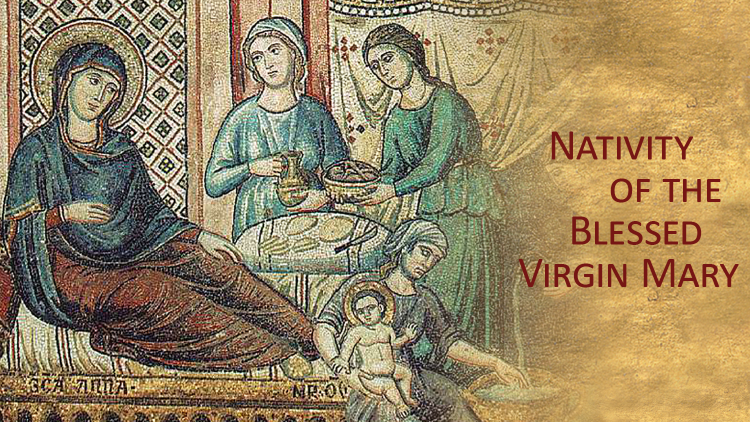
Today the church commemorates the birth of the Blessed Virgin Mary, the Mother of Our Lord Jesus Christ. This feast is tied in with the feast of the Immaculate Conception of Mary nine months earlier on December 8th. Mary had that unique gift of being conceived without original sin, thus preparing her to be the mother of the Savior. Pope Pius IX proclaimed in 1854: “The most Blessed Virgin Mary was, from the first moment of her conception, by a singular grace and privilege of almighty God and by virtue of the merits of Jesus Christ, Savior of the human race, preserved immune from all stain of original sin.”


With the special gifts and graces that God gave her, we hear in scripture how our Lady was ever ready to do the will of God. In Luke, chapter one, verse 28, the angel Gabriel addresses Mary, “Hail, full of Grace…” This is the phrase that the church turns to in her teaching that Mary was immaculately conceived, thus she was full of Grace. Following Gabriel’s greeting of calling Mary “full of grace” he indicates that she will be the mother of the savior. Mary’s response after Gabriel explained how it was to happen was, “Behold, I am the handmaid of the Lord.” (Luke 1:38). This showed that Mary was ever open to the will of God. As a result of her openness to doing the will of God, Jesus was able to come into the world to bring us salvation. This was her “yes” to Gabriel and ultimately to God: “Be it done to me according to your word.”

It is through the working of God’s grace in Mary’s willingness to say “yes” to Gabriel that Jesus was able to come into the world. And further, through St. Joseph’s obedience to the angel in his dreams to take Mary for his wife, that we can learn how we are to live out our lives. We are called to follow the examples of Mary and Joseph: always open to do the will of God, no matter the costs.

Both Mary and Joseph said “yes” to things that seemed impossible or difficult for them to do. In the gospel for today, we hear of Joseph not fully understanding how the woman that he loved could be pregnant. He assumed that she was unfaithful to him and was ready to divorce her quietly in order not to bring shame upon her. But, being a righteous man, he was able to hear God speak to him through his dreams, and thus was able to say “yes” to God in being the foster father of Jesus.

We are all called to say “yes” to God in the various responsibilities of our lives. Whether it’s being a good and loving spouse, a good and loving parent, or a loving and obedient child to our parents. These are different ways that God is calling us to answer the call to bring God into the world. It is in loving those in our lives that we can bring the love of God into the world.

Let us always respond to God as Mary did: “May it be done to me according to  your word.”

Saturday, September 2, 2023

XXII Sunday in Ordinary Time


Today we have a recurring guest blogger:  Fr. Arthur F. Rojas, pastor of PRESENTATION OF THE B.V.M CHURCH, PORT EWEN AND SACRED HEART CHURCH, ESOPUS. For more information on this parish, check out their website at Presentation of the Blessed Virgin Mary & Sacred Heart Churches - Port Ewen - Esopus, NY (presentationsacredheart.org) 

Scripture readings for this homily can be found at Twenty-second Sunday in Ordinary Time | USCCB

Submission to the blog of Dcn. Thomas Tortorella for the XXII Sunday in Ordinary Time

by Rev. Fr. Arthur F. Rojas © All Rights Reserved, August 30, 2023 ©

In Mt 16:21-27, the Gospel reading for Mass in the Ordinary Form on Sunday, September 3rd,

Our Lord reproves St. Peter to bring him to a deeper perception of what Our Lord will go through to redeem mankind from our sins. In the second reading (Rom 12:1-2), St. Paul exhorts us to be renewed in mind by not conforming ourselves “to this age” and instead discerning and following the will of God.

In the first reading (Jer 20:7-9), while St. Jeremiah the prophet rues the call to convey God’s message to his society and laments the trials he passes for his mission, St. Jeremiah knows that he was made by God for that very mission.

Lately, a survey of Anglican ministers in in The Times of London, England (www.thetimes.co.uk) recorded majorities in favor of discarding whatever Biblical and historically Christian elements remain of Anglican tenets on life, love, and morality to fall in line with public opinion of their patently post-Christian country. “You are not thinking as God does, but as human beings do.” Mt 16:23. Since their denomination was engendered by King Henry VIII’s self-interested rejection of Catholic doctrine on marriage and communion with the Holy See, perhaps we should not be shocked by the survey, especially as the Anglicans at their Lambeth Conference of 1930 permitted contraception, which was rejected historically by Christians of East and West and have further followed the spirit of the age instead of the Holy Spirit. Mt 16:23. With the documented decline of affiliation and participation of Anglicans in England and elsewhere, many studies attest also to the failure to stem decline among the mainline Protestant denominations for following similar paths in the United States and elsewhere. Mt 16:23.

Now there is a siren song coming from Germany and elsewhere urging our Church to follow the same path in order to stay “relevant” to contemporary society and not “lose” this or that group. Mt 16:23.

Too much can be made of journeys or accompaniment if the end, which is the sanctification of persons and peoples as well as the salvation of souls, is forgotten or de-emphasized. They forget that while the Old Testament prophet Jeremiah was called from the womb by God to His prophetic service, we Catholics each and all have been transformed by the New Testament’s sacrament of Baptism into a priestly, prophetic, and kingly people (cf. Catechism of the Catholic Church, 1241). Our prophetic mission as Catholics, albeit performed in distinct yet complementary ways by the laity and the clerics, is to convey God’s ways of life, love, and goodness (a.k.a. the Magisterium), whether they are fashionable or not. These ways are not only in matters of life and love but fan out to all aspects of society.

As in the times of Arius, the first major heresiarch, and others who spread moral and doctrinal errors that would mislead many from high and low in society, may we Catholics rediscover, share, live, and defend the riches of the Truth that God has given our Church in Sacred Scripture, the Apostolic Tradition, and the Magisterium, starting with our personal and parish families and then out into the virtual and public lives of our society. Yes, it is easier in this life to “go along to get along” with the spirit of the age. Mt 16:23. But you and I were made for so much more than the esteem of this passing age on Earth. “What profit would there be for one to gain the whole world and forfeit his life?” Mt 16:26. Our thirst for meaning, purpose, and truth can be slaked only by the Living God and His ways, as Psalm 63 reminds us in the responsorial psalm. May we look to the example of St. Jeremiah and other heroes of the True Faith such as the Apostles, St. Athanasius, St. Catherine of Alexandria, St. Thomas More, St. Robert Bellarmine, St. Edith Stein, and people today such as Joseph Cardinal Zen, Bishop Rolando Álvarez, Dr. Janet Smith, and Dr. Anne Nolte to live our prophetic mission today.

Friday, September 1, 2023

Therefore, stay awake, for you know neither the day nor the hour


Scripture readings for today's reflection can be found at Friday of the Twenty-first Week in Ordinary Time | USCCB

In our gospel for today, our Lord is teaching us that we need to always live out our lives in anticipation for the ultimate meeting of the Lord, the Bridegroom, when He calls us to Himself from this life to the next.

The concluding line, “Therefore, stay awake, for you know neither the day nor the hour” reminds me of the old phrase, “Ready or not, here I come!” The wise virgins were always ready with the right amount of oil that was needed for the eventual coming of the bridegroom. They were focused on living out their lives doing God’s will and remained focused on the coming of the bridegroom in order to go to their final reward of heaven. The “oil” that the wise virgins were taking with them during their time waiting was that of loving God and following God’s commandments. They were accumulating the “oil” of righteousness and were pleasing to God as a result.

The foolish virgins appear to be self-centered or selfish, begging the wise virgins for their “oil”. During their lives they weren’t focused on the bridegroom coming to bring them to the heavenly banquet but rather living out their lives for their own selfish needs.

Our oil reserves—a measure of how spiritually ready and prepared we are for the return of Christ—are not a shareable resource. We can’t help each other be more prepared by somehow sharing our readiness with each other. It’s an intensely personal, individual resource. All we can do is build up our own reserves.

The ways we grow spiritually is by the frequent reading of scripture and the regular reception of the Sacraments of Holy Communion and confession. In this way we grow ever closer to God and helps us to grow spiritually closer to the Lord Jesus Christ.

Let us, like the wise virgins, be ready for the Lord when he comes to meet us. Let us live out our lives as God centered Christians. This way, when the groom comes to meet us, we will be ready to greet him.

Friday, August 25, 2023

Love God and love your neighbor


Scripture readings for this reflection can be found at Friday of the Twentieth Week in Ordinary Time | USCCB

In our gospel for today the Lord responds very clearly what the is the greatest commandment of the law: Love God with your whole heart, mind, and soul. He couples this with the second greatest commandment: love your neighbor as yourself. Love of God and love of neighbor is central to what it means to be a follower of Jesus Christ.

Many of us will have no problem loving God fully. After all, God is the reason we have life. Life is a gift from God, and we are to be grateful to him for this gift. But the second part of today’s Gospel, to love our neighbor as ourselves, that’s where many of us start having problems. Human nature being what it is, it’s easy to hate or dislike people that get on our nerves.

Who are these neighbors that the Lord is referring to in the Gospel? The neighbors the Lord is referring to are more than just those living next door to us. Our neighbors are all those people we have in our lives: our family, friends, co-workers, and those people we encounter during our day-to-day routines. It’s not always easy to love these people that God has placed in our lives. Our family members, for example, that know us the best, can be the most difficult to love. These family members are quick to press our buttons when they see that we are not living our lives as they feel we should. But we are to respond to them with love. We are called by Jesus to love everyone, without exception. Further, those people that we encounter at work that are difficult to even like, we are called to love. We must remember that these are all people that are made in the image and likeness of God.

In the first letter of John, chapter 4, verse 20, we read: “If anyone says, ‘I love God, but hates his brother, he is a liar; for whoever does not love a brother whom he has seen cannot love God whom he has not seen.” This sums up what our Lord is teaching in today’s Gospel.

We need to remember that as we encounter people throughout our days, we are also encountering God. We are to treat everyone we meet with the same love and respect that we would give to the Lord Jesus Christ if we encountered him during our journey throughout the day. In Matthew, chapter 25, we hear Jesus teach about the Judgement of the Nations, and in verse 40, the Lord says, “Amen, I say to you, whatever you did for one of these least brothers of mine, you did for me.” So, as we meet people in daily routine, we are to show them the same love and respect that we would show the Lord Jesus Christ.

Let us this day pray to the Lord God asking Him for the strength to continue to love not only Him, with our whole heart, souls and mind, but to also love our neighbor as ourselves.

Friday, August 18, 2023

The two shall become one flesh.


Scripture readings for this reflection can be found at Friday of the Nineteenth Week in Ordinary Time | USCCB

In our gospel for today we are learning from the Lord about the importance of Marriage. The Pharisees were looking at marriage simply as a contract, and not a lifelong commitment between a man and woman. They were looking at it legalistically, not as something that has God in the center of it. Further, the divorces supported by the Pharisees favored the man. You will notice from this gospel passage that the Pharisees mentioned that Moses commanded that a man can give a woman a bill of divorce and dismiss her (Matthew 19:7). This situation always favored the man, and the woman was left with nothing.

Jesus pointed out the hardness of their hearts in regard to divorce. They were failing to see that a man and a woman, once married, become one in the eyes of God. Marriage, in God’s plans, was meant to be forever. As the marriage promises says, “Till death do you part.” Marriage is meant to have love for each other and love of God at its center.

There’s an old country song from many years ago that is called, “Love is the foundation.” Let us remember that in each marriage, the man and woman need to discern their love for each other and realize that God’s love is to be the foundation of who they are as a married couple. Like any vocation, marriage needs to be thought out in advance and discernment is important to determine that it is indeed the right thing to do to enter the marriage bond. This should be true for any couple entering into a marriage: love needs to be the foundation.

Our Lord goes onto indicate that not all are called to be married for various reasons. Mariage is not for everyone. There will be those who choose to not get married, but rather serve God. As Jesus indicates, they renounce marriage for the sake of the Kingdom of heaven. Priest and nuns are examples of those who have renounced marriage for the sake of the Kingdom of heaven. This allows them to be focused on serving the Lord and His Church in their vocation as priests and religious. Further, there are those who have decided to be consecrated virgins, choosing to remain single while serving God in various ministries in the Church.

Mother Teresa of Calcutta once told a couple getting ready to be married, “From the first day of your life together as husband and wife, pray together. For the family that prays together stays together in love, peace, and unity.”

Let’s pray for all married couples, and those preparing for marriage, that they keep God and Love as the foundation of who they are as a married couple. Relationships are not always easy, but as long as love of God and love for each other remain at the center of the marriage, there will be joy in their relationship with one another and with God.

Friday, August 11, 2023

“Whoever wishes to come after me must deny himself, take up his cross, and follow me.”


Scripture readings for today's reflection can be found at Memorial of Saint Clare, Virgin | USCCB

Discipleship, being a follower of Jesus Christ, is a choice. Nobody is forced to take it up. Jesus makes it very clear that it is not an easy way to live. How we understand our life and give it value influences what we consider as “saving” or “losing” our life. It also affects the decisions and actions we make.

We are invited to follow in his footsteps. Like him, we are to be ready to take up our cross, whatever it may be, and carry it behind him. Notice, Jesus tells the disciples to take up their own cross, not his. The cross will be different for each person; it takes the form of some difficult thing. Something not chosen but clear.

Only by uniting our suffering in life to that of Jesus can we carry our crosses. Is there something in our life today or every day that we are struggling under the weight of?

Being a follower of Jesus Christ means to choose to love God with your whole mind, heart, and soul, and to love your neighbor as yourself. These are the choices and decisions we need to make if we are to be disciples of Christ. In all we do in our day-to-day life, we need to know that God is present in all our struggles. Do we make time each day to pray and to give thanks to God for the gift of life that he has given us? There are days when we’re struggling with our problems or health issues. But during these times of struggle, do we turn to God to seek help in our needs? Just being a follower of Jesus Christ doesn’t guarantee good health or no worries. It’s during these times of struggle that we pick up our cross and ask the Lord to help us to carry it. With Christ we offer our struggles up to God realizing that God is there to give us comfort even during our trials. In all things that occur to us in our lives, we need to ask God for the wisdom to see his presence in these struggles. It is through the turning to Christ during our struggles that we will have that peace that can only come from him.

Let us pray for the freedom we need to be able to let go of our cares and worries, to realize that our life is not ours to save; it comes from God and its fullness lies in God. Let us offer all our struggles to the Lord, asking for Jesus to be ever present to help us carry our crosses. Jesus will always be there present to us whenever we turn to him in our needs and cares. It is then that we can find that peace that can come only from the Lord Jesus Christ.

Friday, August 4, 2023

And they took offense at him


Scripture readings for today's reflections can be found at Memorial of Saint John Vianney, Priest | USCCB

There’s an old saying that goes, “Familiarity breeds contempt.” The people of Nazareth knew Jesus since he was a child. They knew him as the son of Joseph the carpenter and Mary. They knew his family as well. He was, to them, just an ordinary person, no better or worse than any one of them. They never expected him to have this wisdom and knowledge that he was now showing. And further, he was doing all these mighty deeds of healing the sick and driving out demons from the possessed. They were asking, “Where did he get all this? He’s just one of us!”

 But Jesus showed that he was more than just that the son of Mary and Joseph the Carpenter. He was showing that he was the Messiah they had long been waiting for. But they struggled with accepting this and were unable to move beyond their preconceived ideas of who Jesus was. He didn’t fit into what they thought the Messiah should be. To them Jesus was just ordinary.

We have come to know that Jesus is certainly no “ordinary person.” We have come to know him as the Savior of the world, the Son of God. Yet there are people that we may know in our lives that have trouble agreeing with us. They view Jesus as just a nice holy man or prophet with teachings on how we are to live out our lives in relationship with God and with others. They cannot accept him as the Messiah. We are called to share with them that Jesus is indeed the Son of God and the Savior of the world.

Today we commemorate the feast of St. John Vianney, born in Lyons, France, in 1786. He struggled in the seminary to comprehend the studies he was expected to know in order to carry out his priestly duties. Further, he struggled with understanding Latin, which was an important part of his seminary training. He finally was ordained, and his superiors decided to send him to a place where they thought he could live out his priesthood with little struggle. They sent him to the small town of Ars and it was there that he started bringing people back to the faith with his down-to-earth preaching and being accessible to them in the sacrament of confession. People were able to feel the love of Jesus in John Vianney. John Vianney was doing in Ars what Jesus did during His ministry. Vianney was showing his parishioners the love God has for each of them. As a result, he was bringing them back to the practice of the faith. His superiors, I’m sure, thought, as the towns people with Jesus thought, “Where did this man get all this?” Jesus was working through John Viany to bring change to those people that he was called to serve in his parish.

Let us, like John Vianney, bring the love of Christ to those in our lives. There will be those that may not accept us and our belief that Jesus is the Son of God, but we are called, like John Vianney, to bring that love of God to all people that we encounter.