Ordination at St. Patrick's Cathedral

Ordination at St. Patrick's Cathedral
June 19, 2010

Friday, July 19, 2024

I desire mercy, not sacrifice


Scripture readings for today's reflection can be found at Friday of the Fifteenth Week in Ordinary Time | USCCB

In our gospel for today we see another confrontation between Jesus and the Pharisees. The Pharisees weren’t concerned about the hunger the disciples were feeling.  They were just looking for a way to trap Jesus and prove that Jesus and his disciples were not obeying God’s law. It was out of jealously and hatred towards Jesus that they were doing this.  Further, the Pharisees were using the Law to maintain their power over the Jewish people. They weren’t concerned about love or mercy towards their fellow Jews. They were just worried about their places of honor among the Jewish people.

The law of Moses was indeed important to the Lord Jesus, but as a means of bringing people into a good and loving relationship with God. The Mosaic laws were meant as a means of helping people turn away from sin, and to turn towards a loving God.

Further, our Lord has taught us that there are two important commandments: Love of God and love of neighbor. Loving God means that we are to be merciful to those in our lives that may be living a life we may not approve of. Family members and friends may be away from relationship with God for any number of reasons. But we are to show them the love and mercy of God to help them to know that God indeed loves them. By treating others in our lives with the love and kindness of God, we are indeed bringing God to them in whatever situation they may be in. Further, we are not to judge them harshly, as the Pharisees were doing in today’s gospel. Instead, we bring the love of God into every situation and pray for those who we know and love for them to be open to the God in their lives. We are to be a conduit for our family and friends to bring them back to a loving God. We are not to judge them, but we are to love them as God does0 and let them know that God is present to them in all their needs.

Tuesday, July 16, 2024

Our Lady of Mount Carmel


Today we commemorate the feast of Our Lady of Mount Carmel, a feast closely associated with the Carmelite Order. This feast and the Carmelite Order can trace its roots back to the 12th Century when a group of Hermits, dedicated to our Lady, formed a community on Mount Carmel in present day Israel. This is also the location long associated with the Old Testament prophet Elijah. It was there that Elijah, in a confrontation, with the false prophets of Baal, showed that there is but one God in Israel.

These 12th century hermits looked to Mary as their spiritual mother and patroness, and over time, the devotion to Our Lady of Mount Carmel spread throughout the Catholic world. This order also would develop into what we now know as the Carmelite Order. Thanks to the Carmelite Order, we have such saints as St. Theresa of Avila, St. John of the Cross, and St. Therese of Lisieux, the Little Flower.

These Hermits came to know that it was through Mary that they can come to know her Divine Son, Jesus Christ. It is through Mary, always pointing towards her Son, that they were able to come into a deeper relationship with Jesus as Lord and Savior. I’m sure they meditated on the gospel of John often where Christ says to the apostle John, “This is your mother.” Then, as you recall, John, from that moment, made a place for Mary in his Home. These hermits also knew well the passage from St. Paul to the Galatians that “God sent his son, born of a woman, born a subject of the Law, to redeem the subject of the Law and to enable us to be adopted as sons.” It is through Mary bringing Christ into the world that we are adopted brothers and sisters in the eyes of God.

Further, we are called to take Mary, in a spiritual sense, into our homes. We are to allow Mary to reach into our hearts for us to follow more closely her Son, Jesus Christ.

It is also customary on the feast of Our Lady of Mont Carmel to be enrolled in the Brown Scapuar of Our Lady of Mount Carmel. According to tradition, Mary appeared to St. Simon Stock, a Carmelite friar, in the 13th century and gave him the scapular as a sign of her protection and intercession. The scapular has since become a widely recognized symbol of the Carmelite tradition and a popular sacramental among the faithful.

By wearing the Scapular, we are reminded of not only our devotion to Mary under the title of Mount Carmel, but to remember our baptismal promises to put on the Lord Jesus Christ. The scapular is not a lucky charm, but a reminder that we are followers of Jesus Christ and are called to live out our lives according to the teaching of the Catholic Church through the intercession of Our Lady of Mount Carmel. These teachings of Christ, taught through the Catholic Church, are very clear: we are to love God with our whole mind, heart and soul, and to love our neighbors as ourselves.

Let us offer all our intentions and concerns to Mary on this feast to intercede for us. We are to give to Mary these intentions and concerns and ask her to bring them into the loving presence of Jesus to respond in a way that’s most beneficial to us and to those who we are praying for.

Our Lady of Mount Carmel, pray for us.

Saturday, July 13, 2024

15th Sunday in Ordinary Time


Today we have a recurring guest blogger:  Fr. Arthur F. Rojas, pastor of PRESENTATION OF THE B.V.M CHURCH, PORT EWEN AND SACRED HEART CHURCH, ESOPUS. For more information on this parish, check out their website at Presentation of the Blessed Virgin Mary & Sacred Heart Churches - Port Ewen - Esopus, NY (presentationsacredheart.org) 

Item for the blog of Dcn. Thomas Tortorella on the 15th Sunday in Ordinary Time

Scripture reading for this reflection can be found at Fifteenth Sunday in Ordinary Time | USCCB

© All Rights Reserved personally by Rev. Fr. Arthur F. Rojas, July 14th, 2024 ©

            In the readings at Mass in the Ordinary Form for part of July, St. Amos the prophet makes his appearance not only at a number of daily Masses but also in the first reading at Mass today (Amos 7:12-15).  Amidst the revolutionary spirit of July in a civil and historical sense (Independence Day on July 4th, 1776 as well as France’s Bastille Day on July 14, 1789), the holy prophet Amos speaks truth to his fellow Hebrews, who in his time were divided politically between the northern kingdom of Israel and the southern kingdom of Judah.  God has Amos focus His message to Israel in particular, for its leaders had allowed Israel’s affluence to smother their people’s God-given sense of compassion to the poor and the marginalized in society.  Since the political division of Hebrews between Israel and Judah caused the northern leadership to set up their own temple at Bethel to deter Israelites from supporting the divinely established Temple at Jerusalem, the message of the prophet Amos was a challenge not only to the king but also to Amaziah the priest, whose position at Bethel relied on royal patronage.  Are we Catholic Americans more open today than Amaziah to a message that exhorts us to look at our society with God’s eyes as to what needs healing and improving as well as to give thanks for our blessings?  Do we support or encourage our clerics and hierarchs to speak to us and to society in general about applying Gospel values to the concrete aspects of our daily lives as individuals as well as communities?  In an age where “cancel culture” still runs rampant, are we willing to support each other in standing up and standing out for Christian values, even when they contradict or even challenge contemporary American culture?
            Centuries after the witness of St. Amos, Our Lord Jesus Christ came to Palestine and established the new Israel, the Catholic Church, to convey His message, the Gospel, in word and in deed to the world as attested partially by Mark 6:7-13, the Gospel reading for today in the Ordinary Form.  Christ endows His first emissaries, the Apostles, with “authority over unclean spirits,” to heal the sick (a prefiguration of the Sacrament of the Anointing of the Sick and the Church’s charitable initiatives), and to preach repentance.  He teaches the Apostles how to handle welcome and rejection.  Although this mission was given firstly to the Apostles, over time and space via the Sacrament of Baptism (and reinforced by the Sacraments of Confirmation and Holy Orders in other ways) you and I as baptized Catholics have been invested by God with a share of Christ as priest, prophet, and king (cf. Catechism of the Catholic Church, paragraphs 1267-68, also 898, 899, 909, 910, 1546).  Together with the ministerial priesthood from Holy Orders, the baptismal priesthood of the Christian faithful is called throughout time and space, including today and including the Hudson Valley, to prepare the world for the return of Christ in glory (cf. Nicene Creed) through private, communal, and sacramental prayer, through our faithful living and sharing of the Gospel and its moral truths with persons high and low, and through the Spiritual and Corporal Works of Mercy. 

Saturday, July 6, 2024

XIV Sunday in Ordinary Time


Today we have a recurring guest blogger:  Fr. Arthur F. Rojas, pastor of PRESENTATION OF THE B.V.M CHURCH, PORT EWEN AND SACRED HEART CHURCH, ESOPUS. For more information on this parish, check out their website at Presentation of the Blessed Virgin Mary & Sacred Heart Churches - Port Ewen - Esopus, NY (presentationsacredheart.org) 

Scripture readings for this reflections can be found at Fourteenth Sunday in Ordinary Time | USCCB

Item for the blog of Dcn. Thomas Tortorella on the XIV Sunday in Ordinary Time

© All Rights Reserved personally by Rev. Fr. Arthur F. Rojas, July 7th, 2024 ©

            Earlier this week, Americans from sea to shining sea celebrated the 248th anniversary of the Declaration of Independence of the incipient United States from the British Empire.  With love for our homeland, many of us held cookouts and parties or even attended events held communally such as fireworks or parades to celebrate the Fourth of July.  Perhaps some of us sang patriotic hymns and taught them to those younger than us.  Maybe a few of us went to Mass or gave prayerful thanks for God’s blessings to our country before the barbequed lunch or grilled dinner.  If so, for those of us who went to Mass or at least gave prayerful thanks to God before a meal, truly “our eyes are fixed on the Lord, pleading for His mercy.” Cf. Psalm 123, the responsorial psalm for today’s Mass in the Ordinary Form.
            The readings of the XIV Sunday in Ordinary Time demand our humility before God and simultaneously prophetic boldness from us Catholics in God’s name to our beloved America.  The first reading from Ezekiel 2:2-5 narrates the moment of God’s sending St. Ezekiel the prophet to his fellow Israelites, “a rebellious house.” Ez 2:5.   Our responsorial psalm, Psalm 123, expresses the honesty of a chastened Israel turning to God for deliverance and admitting Israel’s fault for its dire straits.  Writing to the Corinthians, St. Paul the Apostle perceives God’s curious plan to ensure the humility of St. Paul while glorifying God’s power made manifest in St. Paul’s weakness.  2 Cor 12:7-10 (our second reading).  Finally, a curious limit seems to be placed on the power of Our Lord Jesus in the Gospel today (Mk 6:1-6) not so much for a deficiency of Jesus in His humanity but due to the “lack of faith” (Mk 6:6), namely, the closed minds and hearts, of Jesus’s neighbors in Nazareth.  These Nazarenes thought that they had Jesus all figured out and probably the Torah and Judaism all figured out, thus they thought they had nothing to learn from anyone else.  Ironically, these people closed themselves from Jesus’s life- changing power in body and soul, with only a few exceptions.   Are you or am I any better than they?
            If there is anything that the last few years have taught us, especially by the revelations and admissions of the limits of human science and how quickly many Americans gave up supernatural faith or their God-given rights and responsibilities, is that for all our scientific and technological progress, neither we Americans nor any people on Earth have things all figured out.  Yet with the fullness of Christianity, we Catholics do have a message from God to the world – Thus says the Lord God per Ez 2:4 – to be shared not only orally but also in the very living of our Catholic faith amongst our fellow Americans in times of plenty and in times of hardship.  However, only if we Catholic Americans show ourselves to be more open to the teachings of Our Lord Jesus than His self-satisfied neighbors at Nazareth, only if we show fruits from the power of Christ in and through our lives individually, as families, as parishes, and as communities, would our neighbors in New York and throughout America find credible that in the midst of our human weakness as Catholics, that God’s strength is shown in us and through us, and that truly we Catholics bring “glad tidings” of “the Spirit of the Lord” (Lk 4:18) to our fellow Americans, who have become confused by so many lies and whose moral vision is clouded by so much (self)deception.

Wednesday, June 19, 2024

May I receive a double portion of your spirit.


Scripture readings for this reflection can be found at Wednesday of the Eleventh Week in Ordinary Time | USCCB

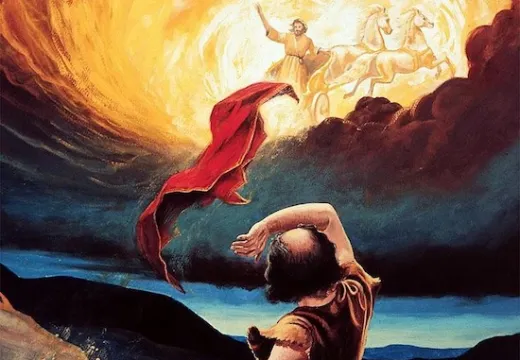
In our first reading for today we hear of the prophets Elijah and Elisha. They both had just finished going from town to town bringing the love of God to Gilgal, Bethel, and Jordon. Elisha followed and served Elijah devotedly in each place that they went. Finally, when it was close to Elijah getting ready to be taken from this world by God, Elijah asks Elisha, “Request whatever I might do for you, before I am taken from you.” Elisha, in his eagerness to serve God, responds, “May I receive a double portion of your spirit.” Once Elijah was taken up to heaven, Elisha did indeed receive the double portion of Elijah’s spirit. Elisha would go on to bring God’s love and healing to all the people he encountered.

In our zeal in following the Lord God, may we be as diligent as Elisha when he requested the Spirit that Elijah had.  We have all received the gifts of the Holy Spirit when we were Confirmed. With the gifts of the Holy Spirit that we all have, we can, like Elijah and Elisha, bring the love of God to all we meet in our lives. We are to be “prophets” in our day-to-day situations, sharing that Jesus Christ is Lord and Savior. Whether it’s within our families, or at work, or in our parish community, we are all called to be like Elijah and Elisha: to be examples of God’s love to all people.

Earlier, in 1 Kings 19:10, we hear Elijah say, “I have been most zealous for the LORD, the God of hosts…” Elijah’s life as a prophet was difficult. He was rejected by the people he was called to serve and to bring the love of God to. People in our lives also may reject our message of the love of God. With the examples of Elijah and Elisha from today’s first reading, let us all be zealous in our service of God by being kind and loving to all people we meet, even those people that we find it difficult to love.


Tuesday, June 18, 2024

But I say to you, love your enemies and pray for those who persecute you


Scripture readings for this reflection can be found at Tuesday of the Eleventh Week in Ordinary Time | USCCB

In our gospel for today the Lord is teaching us about the gospel of love for all people, even those we don't like or who we may consider our enemies. It's interesting that he uses the word "enemy." There are those I know that may not be my "enemy," but I would rather not have anything to do with. Loving these people is not easy, is it?

As our Lord points out, it's easy to love those that we find "lovable" in our lives. But we have to remember that all people we encounter are made in the image and likeness of God. God loves them unconditionally. God loves those people that we may consider to be "jerks!" There are those in our circle of life, whether it's family or people we encounter during the day, that know how to press our "buttons". They know how to say or do things that can hurt our feelings and get under our skin. Further, it is during this time of year when we may be discussing who should win the presidential election. We may get wrapped up in our particular political point of view and hate those who may disagree with what we consider to be true or correct. Or we may hate the candidate that doesn't fit in line with our political point of view. We need to view all people through the lens of love. Then we need to pray for them and their intentions.

Regarding those that may be good at pressing our buttons, it may be best for our own peace of mind to keep our distance from them. But we are still expected to love them and pray for them. We don't have to "like" them, but we need to love them. 

So, let's "So be perfect, just as your heavenly Father is perfect" and love all people as the Lord is calling us to love them.

Friday, June 14, 2024

After the fire there was a tiny whispering sound


Scripture readings for this reflection can be found at Friday of the Tenth Week in Ordinary Time | USCCB

Over the last few days during daily Mass our first reading was from the First Book of Kings in the Old Testament, chapters 17 – 18. We have been hearing of the prophet Elijah, and the struggles he was having in being a prophet for the Lord God. As we heard in today’s readings, Elijah is quoted as saying, "I have been most zealous for the LORD, the God of hosts.” 1 Kings, CHAPTER 19 | USCCB (1 Kings 19:14). Elijah’s love for God was central to who he was as a prophet.

He was anxious to bring the Jewish people away from worshiping false gods to the worship of the one, true, God of Israel. Earlier this week, we heard of the struggle between Elijah and prophets of Baal, and how Elijah was able to prove that there was only one true God. Though at first the people said, “The Lord is God, the Lord is God,” Elijah was eventually rejected by the people, and he ran for fear of his life.

In today’s reading we see Elijah facing his problems and how he was trying to figure out what to do next in his service to God. He was having problems hearing the voice of God above the noise and distractions of all the things going on around him. It wasn’t until he settled down in silence that he hears God’s voice and was able to determine what God was calling him to do.

We can use Elijah as an example of how to live our lives. He was zealous in serving the Lord God of Israel but still had problems with those around him that he was called to serve. We, too, are called to be zealous for the Lord God in all our struggles. People may reject us and our message of love of God, and we may be facing our own problems when we are attempting to live out a God centered life. We need to take time from our busy lives and make quiet time in prayer in order to hear what God is calling us to do in our lives. Further, God will comfort us in our struggles. By having God as the center of who we are and living out our lives zealously for the Lord God, we then can have that peace that can only come from the God the Father, through Jesus Christ and the Holy Spirit.